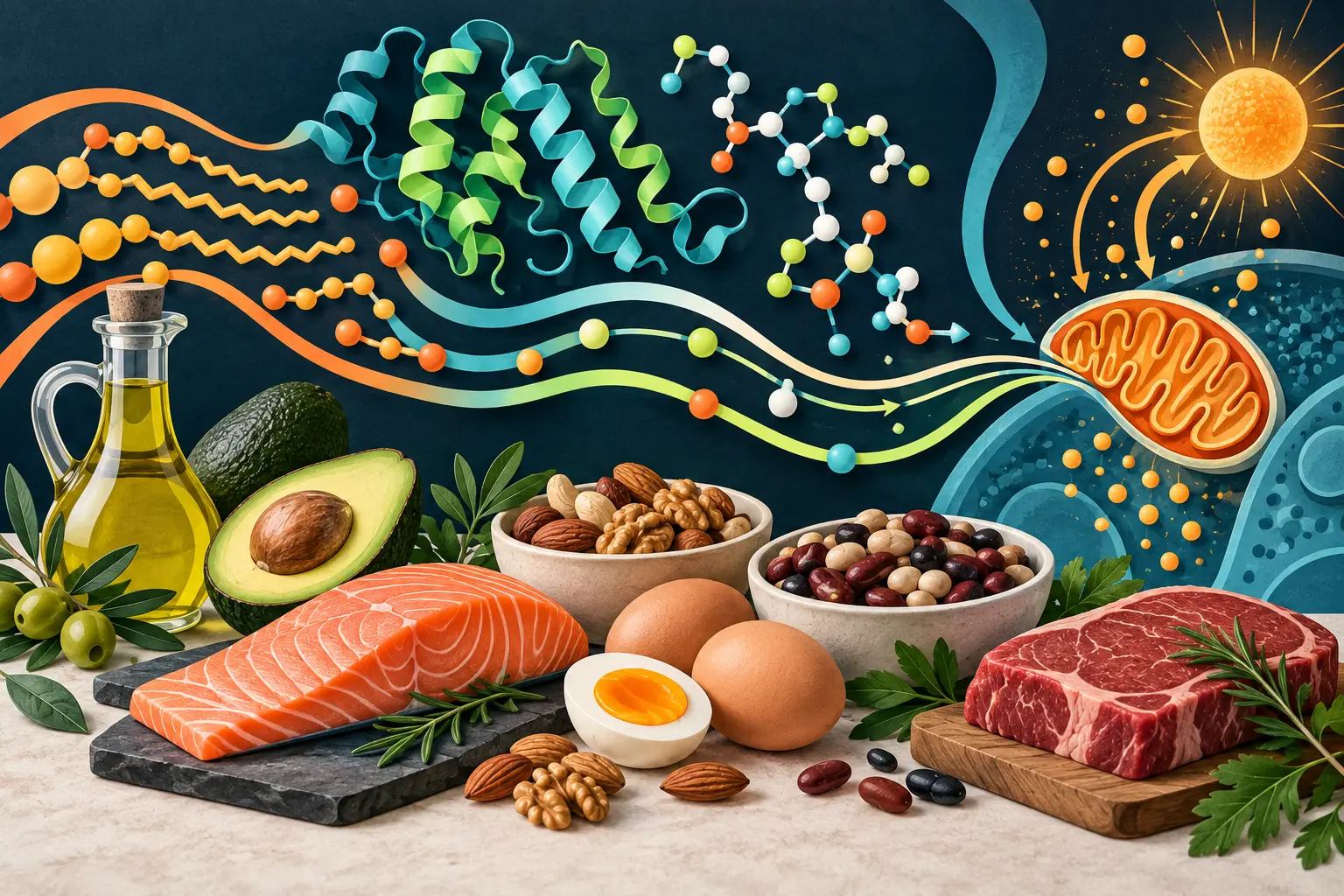
Fats affect satisfaction, food quality, and energy intake, but the word “boost” can obscure those distinctions. Here is how to evaluate the claim without promising extra calorie burn.
Unsaturated fats do not literally wash saturated fat away. A more accurate idea is substitution: replacing some saturated-fat-rich foods with unsaturated-fat-rich foods can improve parts of the blood-lipid profile.
Start with the system, not the slogan
Health content often isolates one molecule, workout, or behavior and treats it as the master switch. The body does not work that way. Energy intake, expenditure, nervous-system signals, hormones, tissue needs, sleep, medicines, disease, age, environment, and behavior interact. A dramatic short-term response does not guarantee a durable result.
A sound explanation tells you what happened, how strong the evidence is, who was studied, the likely size of the effect, and where uncertainty remains. A plausible mechanism is not the same as a demonstrated health outcome. We give more weight to systematic reviews, controlled trials, prospective studies, and established public-health guidance than to testimonials.
What is happening inside the body?
Cells take in raw materials, transform them, use them, store them, and recycle their components. Enzymes make reactions possible. The circulation moves oxygen, nutrients, hormones, and waste. The liver coordinates fuel handling. Muscle uses fuel, stores glycogen, produces movement, and responds to training. Adipose tissue stores energy and sends signals. The brain monitors internal and external conditions.
After a meal, storage and tissue-building signals may rise. Between meals or during activity, stored fuels can be mobilized. During training, recovery, illness, dieting, growth, or aging, priorities shift. The better questions are not simply “Is this stored?” but “What is the overall pattern, what does the body need now, and what happens repeatedly over time?”
How to read the research
Research gives ranges and probabilities, not guarantees. Randomized trials can test cause and effect under defined conditions but may be short. Observational studies can follow large groups for years but cannot remove every confounder. Laboratory studies reveal mechanisms, yet a cellular effect may not produce a meaningful everyday outcome.
Confidence rises when multiple types of evidence point in the same direction and the recommendation is practical and low risk. That supports the foundations: move regularly, include strength work, eat a varied nutrient-dense pattern, sleep adequately, avoid tobacco, and address risky alcohol use. These actions influence many systems at once.
Turn knowledge into an ordinary week
Imagine two futures. In one, you wait for the perfect plan, change everything for ten days, and conclude your body is broken. In the other, you establish a baseline, select one behavior that fits your actual week, collect feedback, repeat what works, and adjust what does not. Six months later, the quieter path is often the more powerful one.
Ask what an ordinary Tuesday should look like three months from now. What food is available? When do you walk? Which strength sessions are realistic? What happens when sleep is poor or travel interrupts the week? A resilient plan includes a smaller version for hard days.
Your practical starting plan
- Use olive oil, nuts, seeds, avocado, and fish as practical unsaturated-fat sources.
- Treat coconut oil as a saturated-fat-rich food, not a metabolism cure.
- Watch portions without fearing fat; it is energy dense and supports satisfaction.
- Judge the overall eating pattern rather than one ingredient.
- Discuss high-dose omega-3 products with a clinician.
Choose one action and make it schedulable. “Move more” becomes “walk ten minutes after lunch Monday, Wednesday, and Friday.” Review after two weeks. Tracking is for learning, not punishment.
Separate signal from noise
Short-term changes can be real without being the result you think they are. A hard workout can increase water retention. A salty meal can increase scale weight. A lower-carbohydrate day can reduce stored glycogen and water. A late meal can change the next morning’s measurement. None of those observations alone proves fat gain or loss, a damaged metabolism, or a successful program.
Look for converging evidence. Combine a trend with how the plan was followed, how you feel, how you perform, and any clinical measures relevant to your goal. Keep measurement conditions similar. Compare like with like. The more emotionally charged a number becomes, the more important it is to examine the whole pattern.
What sustainable progression looks like
Progression means asking the body to do a little more while preserving technique, recovery, and confidence. It can mean more repetitions, a modest load increase, additional walking minutes, a slightly faster comfortable pace, or more consistent meal preparation. It does not require exhaustion.
Adaptation needs both a signal and recovery. Training provides a signal. Food, sleep, lower-intensity time, and appropriate spacing help the body respond. More signal is not always better. When performance falls, irritability rises, sleep worsens, or pain changes movement, reduce load and investigate.
People sometimes compare a mature routine with a beginner’s first week. Capacity is built in layers. The person who walks ten minutes is not failing because someone else walks an hour. The question is whether the next layer is safe, repeatable, and connected to the goal.
Food quality and energy balance can both matter
Energy balance influences body-mass change over time, while food quality influences hunger, nutrient intake, digestion, cardiometabolic health, enjoyment, and sustainability. These ideas are partners. Foods with equal calories can differ in protein, fiber, water, vitamins, minerals, texture, and satisfaction.
A practical meal does not need a perfect formula. Many people benefit from a meaningful protein source, vegetables or fruit, a fiber-rich carbohydrate when appropriate, and a source of fat. Portions and frequency can then be adjusted using hunger, goals, activity, health needs, and trends.
Rigid labels such as clean, bad, toxic, or cheat can hide more than they reveal. Dose, frequency, substitution, and the overall pattern matter. Enjoyment matters too. A plan that makes social life impossible or turns meals into anxiety has a cost.
Recovery is active work
Sleep influences attention, appetite, mood, training quality, and recovery. One difficult night does not ruin metabolism, but repeated inadequate sleep can make useful choices harder and change how effort feels. Protecting sleep opportunity is a performance strategy.
Stress is not merely a hormone story. It changes schedules, food availability, alcohol use, social connection, and willingness to move. Management may include problem solving, counseling, prayer or reflection, time outdoors, breathing practices, boundaries, and support. No single method is universally best.
Recovery means respecting symptoms. Escalating pain, persistent exhaustion, dizziness, fainting, chest discomfort, unexplained shortness of breath, or rapid unexplained weight change should not be treated as motivation problems. General wellness content has limits.
Personalize without abandoning evidence
Personalization begins with evidence and adjusts for the person. Start with broadly supported principles, identify constraints, choose an acceptable version, and test it. A vegetarian and an omnivore can both build adequate protein patterns. A person who dislikes gyms can train at home. Limited mobility can be accommodated with qualified help.
Culture, budget, cooking skill, work schedule, caregiving, neighborhood safety, disability, and access to care are design inputs. Advice becomes useful when it acknowledges them. The best plan on paper is not the best plan if it cannot live in the person’s world.
Review the plan periodically. Needs change with age, injury, work, family life, training, disease, and goals. What worked five years ago may need modification without implying the earlier approach was wrong. A good system evolves while keeping its foundations recognizable.
Why individual results differ
Two people can follow similar plans and see different rates of change. Starting size, lean mass, age, genetics, movement, training history, sleep, medicines, health conditions, food access, stress, and measurement error all contribute. Difference does not mean failure. It means the plan needs enough time and context.
Daily scale weight is noisy. Water, sodium, carbohydrate intake, bowel contents, hormonal changes, training inflammation, travel, and alcohol can move the number without an equivalent change in body fat. Weekly trends, performance, and relevant clinical markers tell a better story together.
Estimates are hypotheses. A calorie equation is a starting point, not a metabolic verdict. A step target makes movement visible, not moral. Use numbers to support judgment, then update them from real outcomes.
Build a feedback loop
A useful loop has four parts: choose a small action, record whether it happened, notice the result, and adjust. Two to four weeks is often more informative than two to four days. Change one major variable at a time when possible.
Progress includes capacity. Can you walk farther without unusual fatigue? Carry groceries more comfortably? Recover between sessions? Is breakfast more satisfying? Are you sleeping consistently? These questions capture the lived value of health behaviors.
Plateaus are information. The original estimate may be high, portions may change, movement can fall, sleep can deteriorate, or a smaller body may require less energy. The answer is not always greater restriction. Review food, movement, training, recovery, health, and the timeline.
Environment often beats willpower
Motivation changes. Environment can keep helping when motivation is low. Put walking shoes where you see them. Keep convenient food available. Schedule strength sessions like appointments. Use smaller defaults instead of heroic decisions after a stressful day.
Friction works both ways. Preparing ingredients reduces cooking friction. A ten-minute routine reduces exercise friction. An unrealistic plan with special foods, long commutes, or rigid timing adds friction until ordinary life wins.
Your information environment matters. Prefer educators who show sources, explain limitations, correct errors, and avoid diagnosing strangers. Trust grows when someone admits uncertainty or explains why an average may not apply to you.
Common questions
Do I need motivation first?
No. Action can precede motivation. Design a minimum version: five minutes of walking, one set, or one balanced meal. The minimum keeps the routine alive.
How fast should I change the plan?
Fast enough to learn and slowly enough to interpret. Change unsafe, painful, or clearly unsustainable behavior now. Otherwise allow normal variation to settle.
Is soreness proof exercise worked?
No. Soreness can follow novelty, but it is not required for adaptation. Severe pain, swelling, weakness, dark urine, chest pain, or neurological symptoms may require care.
Do supplements boost metabolism?
Most marketed boosters produce small, inconsistent, or clinically unimportant effects, and some carry interaction or contamination risks. Discuss products with a pharmacist or clinician.
What if I miss a week?
Restart below your previous peak rather than repaying a debt. Consistency is not an unbroken streak; it is the skill of returning.
A four-week experiment
Week one: observe. Record the behavior without trying to be perfect. Note timing, context, hunger, energy, sleep, or discomfort.
Week two: anchor. Attach one action to an existing event. Walk after lunch, add protein at breakfast, or complete a short routine on two named days.
Week three: progress. Add a small amount only if the anchor works.
Week four: review. Look for patterns rather than judging yourself. Decide what to keep, simplify, or discuss with a professional.
Your next best decision
The purpose of learning is not to collect more health facts; it is to improve the next decision. Choose a decision close enough to act on today. That may be scheduling a walk, planning two strength sessions, adding a satisfying food to breakfast, counting standard drinks honestly, arranging a medical appointment, or asking for support. A concrete next step creates information that another hour of scrolling cannot.
Write down what you expect to happen and when you will review it. If the result differs from the expectation, that is useful. Revise the model instead of blaming the person. Sustainable health work is a cycle of education, action, observation, and refinement. It becomes more accurate as it meets real life.
Keep the foundation visible while exploring details. No isolated nutrient, exercise, supplement, or metric carries the entire system. The long game is to build enough knowledge to resist hype, enough structure to act consistently, and enough flexibility to return after interruption. That is how information becomes capacity—and how capacity becomes a healthier future.
Before moving on, summarize the main idea in your own words. Then name one claim you want to verify, one behavior you can test, and one person who can help. Teaching the concept to someone else exposes gaps in understanding. Saving the source links makes later review easier. Health literacy grows through repetition: define the terms, inspect the evidence, notice the limits, and connect the finding to a proportionate action. You do not need certainty about every mechanism before taking a sensible, low-risk step.
When professional guidance matters
Ask how your medical history, medicines, injuries, sleep, laboratory findings, and current intake modify general advice. Ask which symptoms should stop activity and what progress measures matter beyond scale weight. Persistent fatigue, unexplained weight change, pregnancy, eating-disorder symptoms, major chronic disease, or substance-use concerns deserve individualized care.
This education does not diagnose or treat disease. Good health information should help you ask better questions—not persuade you to treat yourself in isolation.
Keep exploring dietary fat and fatty acids
For the wider context, visit the Dietary fat and fatty acids collection. These related questions may help you choose what to read next:
Sources and further reading
We prioritize government health agencies, peer-reviewed literature, and professional consensus statements.